Home / Procedures / Oral cysts and tumours
Oral and maxillofacial surgery · Brisbane
Oral cysts and tumours
Lumps and lesions in the mouth and jaws are most often benign. Dr Tuckett examines them, arranges the right investigations, confirms what they are and coordinates treatment. Consultations are held at each of his rooms.
What they are
About oral cysts and tumours
Oral cysts and tumours can affect the mouth and associated structures such as the lips, palate, teeth, jaws, tongue and gums.
The complex anatomy of the head and neck region and the requirement for knowledge of Medicine and Dentistry make accurate diagnosis of oral pathology a clinical challenge.
Often patients are referred to a specialist Oral and Maxillofacial Surgeon to examine, investigate, diagnose and coordinate the management of the pathology.
About mouth diseases
The most serious disease of the mouth is oral cancer, and any lesions that are found to be malignant (cancerous) usually need to be surgically removed.
Benign (non-cancerous) lesions are also usually surgically removed as they can cause damage to surrounding tissues and often the benign diagnosis requires the lesion to be removed and sent to a pathologist to examine under a microscope.
This includes cysts (fluid filled lesions) and tumors (solid lesions).
Both can result in swelling, pain and infection. They can also increase in size, affecting nearby teeth and causing destruction of the jaw bone.
How it's assessed
How do you treat diseases of the mouth?
The aim is to find out what the lesion is, and to rule cancer in or out, before any treatment is planned. It is important for all patients to know that oral cancer is rare compared to the many benign lesions of the oral cavity. However, prompt assessment is necessary because if cancer is not detected early, then treatment outcomes can be adversely affected.
History and examination
At the initial consultation Dr Tuckett will take a thorough history and examination while also undertaking cancer screening and arranging appropriate investigations.
The likely diagnosis
Dr Tuckett will discuss with you the most likely diagnosis and advise the appropriate investigations to confirm the diagnosis and/or exclude cancer.
Results and next steps
Once the results are in, you're booked in to discuss them and any further treatment that's needed.
Investigations
Investigations can include biopsy of the lump or lesion, imaging such as an Orthopantomogram (OPG X-ray), Ultrasound, CT, MRI or PET scans. Depending on the pathology you may be required to have a blood test.
- Biopsy of the lump or lesion
- OPG X-ray (orthopantomogram)
- Ultrasound
- CT scan
- MRI scan
- PET scan
- Blood test, depending on the pathology
Biopsy and treatment
Where will I have my surgery?
In the rooms, with local anaesthetic
Depending on your personal circumstances and the location of the lesion, you may have the option of having a biopsy performed on the day of your initial consultation. This will be performed under local anaesthetic with injections to numb the area so you do not feel any discomfort.
- A small sample of tissue is taken and sent to the laboratory for review and microscopic analysis by a specialist Pathologist, sometimes this can incur a fee from the pathologist.
- Dr Tuckett will usually have the results of the biopsy within one week and will schedule an appointment for you to discuss the results and any further treatment that is required.
In hospital, under general anaesthetic
Definitive treatment of cancerous lesions and larger benign lesions is performed in hospital under general anaesthetic.
- The plan depends on what the lesion is and where it sits.
- Dr Tuckett explains it to you before you decide.
After your procedure
What is recovery like after my procedure?
After your procedure, Dr Tuckett will provide you with specific instructions regarding your post-operative care, general instructions are available here.
Any required prescriptions for antibiotics or pain relief will also be given to you.
You will receive a follow-up phone call from Dr Tuckett or his staff in the couple of days after your surgery. If you remain in hospital, Dr Tuckett will continue to see you each day until you are discharged.
A post-operative follow-up appointment is usually scheduled for 2 weeks after your procedure, unless otherwise advised. If you have any concerns, call the rooms on (07) 3063 7675 or, after hours, 13 HEALTH. Do not hesitate to contact him.
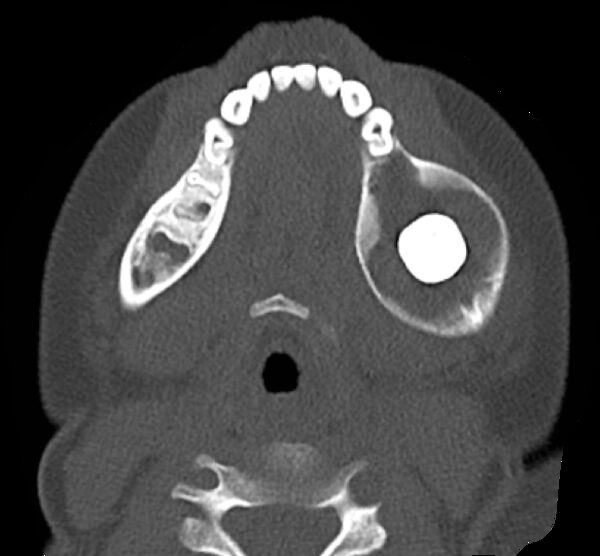
General information only. This page can't tell you what's happening in your own mouth, and the example scan isn't a diagnosis. That takes an examination and your own investigations. Surgery carries risk, and Dr Tuckett will go through it with you at your consultation, before you decide.
For dentists and GPs
Referring a patient with a lump, lesion or cyst in the mouth or jaw? Send it the way that suits your practice. Include the OPG or other imaging if you have it.
- Online referral form
- Fax
- PDF referral
Questions
Oral cysts and tumours questions
What's the difference between a cyst and a tumour?
A cyst is a fluid-filled lesion and a tumour is a solid lesion. Both can be benign (non-cancerous) or, in the case of some lesions, malignant (cancerous). A tissue sample examined under a microscope is how the diagnosis is confirmed.
Will I need a biopsy?
Often, yes. A biopsy takes a small sample of tissue, which is sent to a specialist pathologist for microscopic analysis. Depending on your circumstances and where the lesion is, it may be possible to have it done on the day of your first consultation, under local anaesthetic.
How long do biopsy results take?
Dr Tuckett will usually have the results within one week, and will schedule an appointment with you to discuss them and any further treatment that's needed. The pathologist can sometimes charge a fee.
Where is treatment done?
A biopsy may be done in the rooms under local anaesthetic. Definitive treatment of cancerous lesions and larger benign lesions is performed in hospital under general anaesthetic.
What happens after surgery?
You'll get specific instructions for your care and any prescriptions you need. You'll have a follow-up phone call in the couple of days after surgery, and a follow-up appointment is usually scheduled for 2 weeks after your procedure, unless you're advised otherwise. If you have any concerns, call the rooms on (07) 3063 7675 or, after hours, 13 HEALTH. More on the after surgery care page.
Will I be charged a pathology or lab fee to look at the biopsy specimen?
Usually if the procedure is undertaken in the rooms, the pathology company will bulk bill the cost, meaning no out of pocket lab fee for you. Sometimes they will charge a fee depending on the complexity of the assessment required or if the specimen is taken in a hospital. Dr Tuckett is not affiliated with any specific laboratory and has no say in their fees.
Book a consultation
Call the rooms on (07) 3063 7675, or send an enquiry and the team will come back to you.