Home / Procedures / Dental implants
Oral and maxillofacial surgery · Brisbane
Dental implants
Dental implants allow new custom teeth to be securely placed in the mouth. They can replace a single missing tooth, or all the teeth in the upper and/or lower jaw. Dr Tuckett places the implant in the jaw bone, and your dentist makes the teeth that attach to it. Consultations are held at each of his rooms.
How it works
An implant and a prosthesis: two parts, two people
Dental implants allow new custom teeth to be securely placed in the mouth. Dental implants can replace a single missing tooth or replace all the teeth in the upper and/or lower jaws.
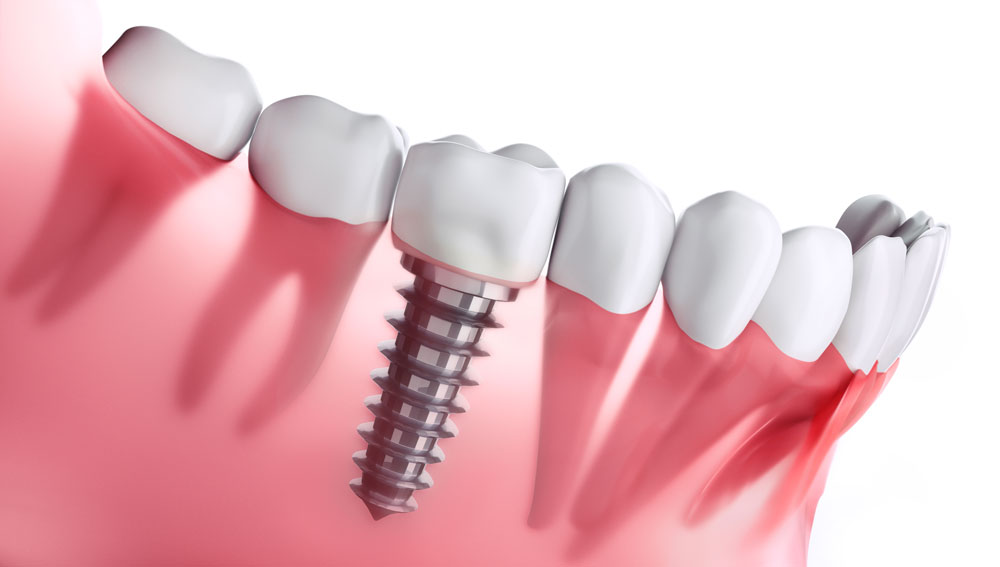
Dental implants are carefully, surgically placed in the bone, their specialised coating encouraging natural bone growth to secure them in place. Once stable, they act as a point of firm attachment for dental prostheses including single teeth/bridges/removable or fixed dentures.
The implant
An implant fixture is inserted into the jaw bone by Dr Tuckett to provide a base for supporting and attaching the prosthesis.
- Implants may be made of different materials and attach in different ways
- You and Dr Tuckett can discuss which is likely to be best for you
The prosthesis
A dental prosthesis is an artificial tooth or row of artificial teeth which your Dentist will attach to the implant. The prosthesis may be a 'crown' to replace one missing tooth or a 'bridge' to replace several missing teeth.
- A crown replaces one missing tooth
- A bridge replaces several missing teeth
- In a jaw with no teeth, the prosthesis covers almost the full dental arch
- Some prostheses with many teeth are fixed permanently onto the implants with screws or special cement. Other types of prostheses can be taken out for daily cleaning.
Is it for you?
Who may need an implant
People who have missing teeth or are soon to have a missing tooth may benefit from dental implants.
Whether an implant is the right choice is a decision for you and Dr Tuckett at your consultation. He explains the options available for your treatment, discusses the procedure and any associated risks in depth, and tells you what to expect afterwards.
Bring with you
Any x-rays or CT scans you have already had organised. Dr Tuckett will advise if any further investigations are required.
The journey
From first appointment to finished teeth
Five steps, shared between Dr Tuckett and your dentist or prosthodontist.
-
Step 1
Consultation
At your initial consultation, Dr Tuckett will take a thorough history, perform a comprehensive examination and review any x-rays or CT scans which you may have organised. He will advise if any further investigations are required.
Dr Tuckett will explain to you the options available for your treatment condition and discuss the procedure and any associated risks in depth. He will also advise you of what to expect in the post-operative period.
-
Step 2
Implant surgery
Dr Tuckett will make an incision to open your gums. The implant is then inserted into the jaw bone using special techniques and instruments. The number of implants inserted by Dr Tuckett depends on the prosthesis. For example, one implant is used to replace one missing tooth. For a complete upper prosthesis having 12 artificial teeth, four or more implants may be needed.
The incision is closed with dissolvable stitches. These stitches dissolve within 7-14 days.
-
Step 3, about three months
Healing
The bone surrounding the implant is allowed to heal. Usually the bone has healed and a tooth can be placed three months after surgery. Dr Tuckett will give you specific care instructions after your procedure. General after surgery care is here.
-
Step 4, several weeks
The healing abutment
After healing, a 'healing abutment' is inserted through the gums and into the implant. This can be done under local anaesthesia. The abutment is the foundation, support or connector for the prosthesis. The gums around the abutment are left to heal for several weeks. If the bone is adequate, the abutment may be inserted at the same time as the implant.
-
Step 5
The prosthesis
Your Dentist or Prosthodontist will then begin work on the prosthesis. The prosthesis may be fixed to the implant with cement or screws so that it is not removable. Or it may be attached in a way that allows it to be removed for cleaning.
Where you'll have surgery
Awake and numb, or asleep
Which one suits you depends on how many implants you need and what you'd prefer. You and Dr Tuckett decide together.
Local anaesthetic
If only one or a few implants will be inserted, Dr Tuckett may give you a local anaesthetic with a needle. The local anaesthetic will numb the gums and the lower parts of the face.
General anaesthetic
For some people, Dr Tuckett may recommend general anaesthesia, that is putting them to sleep for the duration of the surgery. General anaesthesia is usually the recommended way to place implants as it is more comfortable for patients. It is given by a specialist Anaesthetist who will put you to sleep and wake you up safely.
General Anaesthetic may be preferred in people who:
- Will have implants inserted into the lower jaw, upper jaw or both.
- Do not want to remain awake during the surgery.
- Will need major bone grafting.
About risk. Dr Tuckett discusses the procedure and its associated risks with you in depth at your consultation, before you decide. After your procedure he gives you specific instructions for your care, and those are the ones to follow.
After your procedure, Dr Tuckett will provide you with specific instructions regarding your post-operative care, general instructions are available here.
For dentists and GPs
Referring a patient for dental implants? Send it the way that suits your practice. Include any x-rays or CT scans you have.
- Online referral form
- Fax
- PDF referral
Questions
Dental implant questions
What is a dental implant?
An implant fixture is inserted into the jaw bone by Dr Tuckett to provide a base for supporting and attaching a prosthesis. The prosthesis is an artificial tooth or row of artificial teeth that your dentist attaches to the implant.
How many implants will I need?
The number depends on the prosthesis. One implant is used to replace one missing tooth. For a complete upper prosthesis with 12 artificial teeth, four or more implants may be needed.
How long does the bone take to heal around an implant?
The bone surrounding the implant is allowed to heal. Usually the bone has healed and a tooth can be placed three months after surgery. After that, a healing abutment is inserted and the gums around it are left to heal for several weeks.
Will I be awake for implant surgery?
If only one or a few implants will be inserted, Dr Tuckett may use a local anaesthetic to numb the gums and the lower parts of the face. For some people he may recommend general anaesthesia, given by a specialist anaesthetist.
Are the stitches removed after implant surgery?
No. The incision is closed with dissolvable stitches, which dissolve within 7 to 14 days.
Who makes the new teeth?
Your dentist or prosthodontist works on the prosthesis after the abutment has healed. Dr Tuckett places the implant fixture in the jaw bone.
Book a dental implant consultation
Call the rooms on (07) 3063 7675, or send an enquiry and the team will come back to you.